
Colour prediction · Guide
Lottery 7 Colour Prediction: How Rounds Work and Why No Trick Wins
Lottery 7 colour prediction is the round-based game most people mean when they talk about Lottery 7. It looks simple — pick a colour, wait for the timer — but there is a lot of misleading advice around it. This guide explains how a round works, what the options mean and why no prediction method can guarantee a win.
- Updated October 2026
- 7 min read
- Independent guide
- 18+ only
Quick answer
Lottery 7 colour prediction is a timed game: you pick a colour, number or size before the countdown ends, and entries are settled when the round closes.
Each round is independent. Charts, “patterns” and paid signal groups cannot reliably predict the next result.
On this page
What Is Lottery 7 Colour Prediction?
Colour prediction is a fast, timed game. During each round you choose an outcome before the countdown ends. When the round closes, a result is generated and entries are settled according to the game’s rules. Some players also call it colour trading, although it involves no trading of any kind.
Each round has a timer and a period number that identifies it. Results are shown in a history list so you can see previous outcomes.
The exact options, payouts and limits are set by the operator of the service you use. Always read the rules screen inside the game, because similar-looking platforms can settle rounds differently.
The Usual Options in a Round
Most colour prediction games offer three kinds of choice:
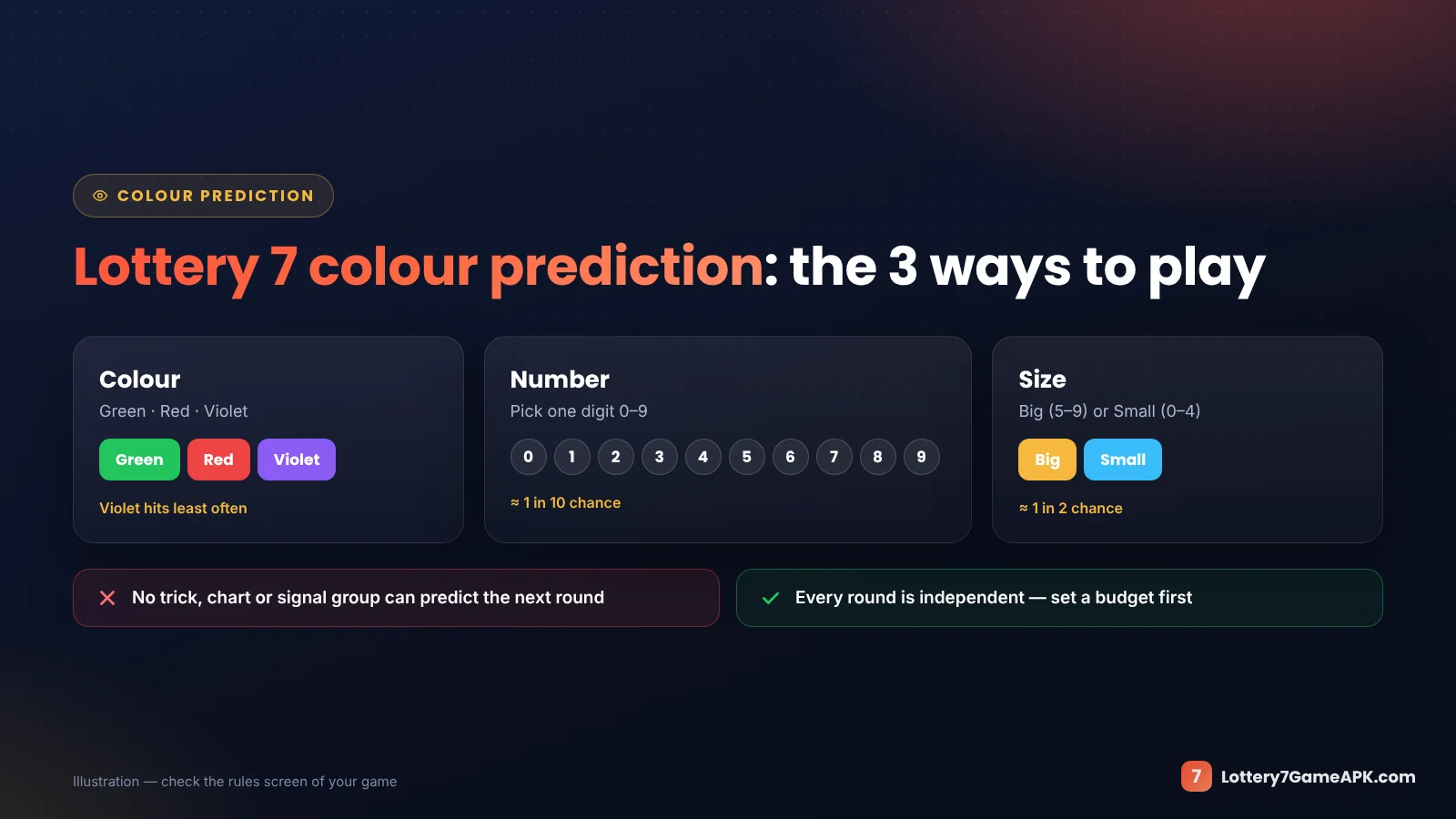
| Choice | What you predict | Note |
|---|---|---|
| Colour | Green, Red or Violet | Violet is typically linked to only a few numbers, so it pays more but hits less often |
| Number | A single digit from 0 to 9 | Highest payout, lowest chance |
| Size | Big (5–9) or Small (0–4) | Roughly even chance, lower payout |
In many versions, each number is also tied to a colour — for example some numbers count as both a main colour and Violet. These links change how entries are settled, so check the exact mapping in the rules before you play.
How a Round Works, Step by Step
- The timer starts. A new period opens with a countdown (commonly one, three or five minutes).
- You choose and confirm. You select a colour, number or size and the amount. A small service fee may be deducted from each entry on some platforms.
- Entries close. Near the end of the countdown, new entries are blocked.
- The result appears. A number is drawn and its colour and size follow from it.
- Settlement. Winning entries are credited according to the payout rules; others are lost.
Our Wingo rules guide covers timers and payouts in more detail.
Why No Prediction Method Is Reliable
Search for lottery 7 colour prediction trick or hack and you will find charts, “patterns” and paid signal groups. None of them can reliably tell you the next result, for three reasons:
Rounds are independent. A run of five greens does not make red “due”. This belief is known as the gambler’s fallacy.
History shows the past, not the future. A result history is a record. Spotting patterns in random data is easy; using them to win consistently is not.
The maths favours the house. Payouts are set so that, over many rounds, the platform keeps a share. Even if you win some rounds, repeated play tends to cost money.
If a group guarantees profit, ask why they are selling the “method” instead of using it. The honest answer is that the subscription fee is the real business.
Common Colour Prediction Mistakes
- Doubling after every loss. Martingale-style doubling grows stakes very quickly and can wipe out a balance in a few rounds.
- Chasing losses. Increasing stakes to win back money is a classic warning sign of problem gambling.
- Ignoring the fee. A small fee per entry adds up over hundreds of fast rounds.
- Playing on autopilot. One-minute rounds make it easy to lose track of time and money.
- Trusting screenshots. Profit screenshots in groups are easy to fake and say nothing about your own results.
Playing More Safely
If you choose to play, treat it as paid entertainment:
- Decide your budget before you start and never top up mid-session.
- Set a time limit — fast rounds make time disappear.
- Never borrow, use rent or bill money, or chase losses.
- Keep your Lottery 7 login details and OTPs private.
- Take breaks and step away when play stops being fun.
More practical steps are in our responsible gaming guide.
Final Word on Colour Prediction
Lottery 7 colour prediction is a game of chance in fast, repeated rounds. Learn the rules, read the period and result history correctly, and ignore anyone selling certainty. Only play with money you can afford to lose, and stop if it starts to affect your sleep, work or relationships.
Frequently Asked Questions
Short answers to the questions people ask most.
How does Lottery 7 colour prediction work?
You choose a colour, number or size before a timed round ends. When the round closes, a result is generated and entries are settled using the game’s payout rules.
Is there a trick to win Lottery 7 colour prediction?
No. Each round is independent, past results do not predict the next one, and paid signal groups cannot guarantee wins.
What is Violet in colour prediction?
Violet is usually tied to a small number of results, so it pays more but occurs less often. Check the in-game rules for the exact numbers and payout.
Is colour prediction the same as colour trading?
Yes, the terms are used for the same kind of game. Despite the name, it is a game of chance, not a trading or investment product.
Can I earn a regular income from colour prediction?
No. It is real-money gaming with a built-in house advantage and should never be treated as a source of income.
More Lottery 7 help guides
Related step-by-step guides for downloading, account access and payments.
18+
Play responsibly. Lottery 7 and similar colour prediction games involve real money and real financial risk. Lottery7GameAPK.com is an independent information website — we are not the game operator, we do not run accounts or process payments, and we never ask for your password, OTP or payment PIN. Read our responsible gaming guide.